Blog
Preventing Physical and Sexual Abuse – It’s Not Either/Or
Across social services, behavioral health, and residential care settings, we hear a familiar refrain:
“We know sexual abuse prevention is important, but our biggest risk is physical abuse.”
This sentiment reflects the realities leaders see in incident logs, claims data, and frontline reports. Physical altercations, injuries, and client aggression often appear more frequent, more visible, and more operationally disruptive.
But this framing is also incomplete.
When organizations treat physical abuse and sexual abuse as separate risk categories, they may fragment their prevention strategy. The evidence increasingly suggests these risks are not parallel tracks. Instead, they are symptoms of the same underlying system failures.
Physical Abuse and Sexual Abuse Share the Same Root Causes
Across child welfare, behavioral health, adult residential services, education, and youth-serving sectors, research consistently identifies a short list of environmental and organizational conditions that elevate all forms of maltreatment:
- Inadequate supervision structures and inconsistent monitoring of programs
- Unclear staff roles and weakly defined or inconsistently enforced professional boundaries
- Poorly designed, aging, or repurposed physical environments that limit supervision and increase opportunities for privacy
- High-stress settings with limited de-escalation training, certification, or skill-development for staff
- Weak reporting pathways and underutilized internal feedback loops that create barriers for elevating concerns
- Inconsistent leadership visibility and reinforcement of safety priorities
Under these conditions, both physical and sexual abuse become more likely. What changes is not the underlying drivers of harm, but how that harm ultimately shows up.
The False Choice Between “Sexual” and “Physical” Abuse Risk
Leaders are often led to believe they must choose which risk to prioritize. This creates a zero-sum conversation:
- If we invest in sexual abuse prevention, we will neglect physical safety.
- If we focus on restraint reduction and injury prevention, we are addressing our “real” exposure.
This logic is understandable, but structurally flawed. The same systems that prevent sexual abuse can also reduce physical harm. For example:
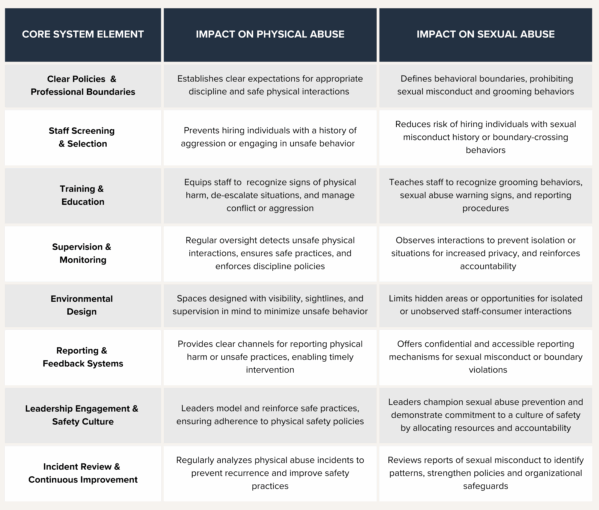
When protections against one type of abuse improve, the safeguards for other types of abuse are strengthened in tandem.
The Systems Lens: What We Are Seeing Across the Field
Across social services, behavioral health, and residential care settings, a consistent pattern has emerged: organizations initially approach prevention efforts through the lens of the most visible incidents—most often physical altercations or injuries that trigger licensing citations or insurance claims—but over time discover that these events are downstream consequences of deeper system vulnerabilities.
In high-acuity environments, incidents rarely occur in isolation. They cluster where supervision breaks down, where staffing is stretched thin, where policies are not actively embedded into daily practice, and where reporting pathways feel unclear or unresponsive.
Abuse in any form points back to the same foundational issue: system-level risk factors left unaddressed.
What the Data Continues to Show
While sexual abuse is statistically less frequent than physical incidents in most behavioral health and social service environments, its impact is disproportionate:
- Higher likelihood of litigation
- Long-term trauma and service disruption
- Significant erosion of trust with families, regulators, and funders
- Reputational damage that outlives any single event
- Operational and financial strain that diverts resources from program delivery
More importantly, when organizations experience substantiated sexual abuse cases, retrospective reviews almost always reveal the same patterns: missed warning signs, prior boundary issues, inadequate documentation, and leadership that underestimated or underreacted to early risk indicators. In many cases, those same warning signs are present well before physical abuse incidents escalate.
From Risk Categories to Risk Architecture
The most resilient organizations are no longer asking: Which type of abuse is our biggest problem?
Instead, they ask broader questions that help identify root causes and systemic solutions: “How does our system create conditions that make harm more likely?“
This shift positions prevention not as compliance but as a core operational function, requiring answers to questions like:
- How do we design supervision to align with the areas of greatest risk?
- How do we ensure staff clearly understand what appropriate behavior looks like in practice?
- How do we capture and react to internal feedback and concerns early, before any form of harm escalates?
- How do we make safety a leadership-level priority, enabling proactive intervention rather than a reactive response?
By addressing systemic vulnerabilities, a functioning and appropriately resourced safety culture strengthens all aspects of safety, reducing the likelihood of both physical and sexual harm by reinforcing boundaries and managing risk continuously rather than incident-by-incident.
Moving from Risk Awareness to Risk Architecture
Most organizations do not struggle because they ignore abuse. They struggle because they attempt to manage harm through isolated responses rather than intentional system design.
Physical abuse, sexual abuse, boundary violations, staff misconduct, and consumer-to-consumer harm are not discrete safety challenges. They are different expressions of the same operational reality: how people are supervised, supported, trained, monitored, and held accountable.
Leaders committed to reducing injuries, mitigating liability exposure, and protecting those they serve must shift the focus from prioritizing one category of risk over another to reinforcing the systems that make harm less likely overall.
If your organization is ready to evaluate how your environment either amplifies or mitigates abuse risk, Praesidium can help. Through consulting, policy review, training, and accreditation, we support organizations in building prevention systems that do not just respond to incidents but prevent them.
The critical question is no longer whether sexual abuse prevention is your primary risk. Instead, are your systems strong enough to protect against all forms of abuse risk?